

SERGEI CHEPIK (1953-2011)
Biography
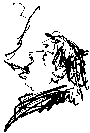
For 20 years, Sergei Chepik—a Russian artist who obtained French citizenship in 1993—was hailed by the Anglo-Saxon press as “a searing visionary” and “one of the greatest living Russian painters”. Represented in important British, Russian, French and American collections, this “unclassifiable” artist painted the portraits of Rudolf Nureyev and Margaret Thatcher, and created a set of four monumental canvases for London’s Saint Paul’s Cathedral entitled The Way, The Truth, The Life, inaugurated in January 2005. He lived and worked in Paris from 1988 until his premature death on November 18, 2011—the feast of the dedication of Saint Peter’s and Saint Paul’s basilicas.
Born in Kiev in 1953 to an artist-painter father and sculptress mother, Chepik took up painting at the age of five. Admitted to the prestigious Saint Petersburg Academy of Fine Arts (Ilya Repin Institute), he graduated with flying colours in 1978 and immediately embarked upon his early works, travelling across Russia and perfecting his art in the class of Academy member Andrei Mylnikov, himself a pupil of Igor Grabar, one of the theoreticians of the World of Art Movement led by Sergei Diaghilev and Alexandre Benois. From his long years of training with such open-minded, demanding masters, Chepik always maintained an obsession for professionalism, a taste for excellence and a respect for the artistic heritage of centuries past.
The House of The Dead (his masterpiece, which was banned from being shown in the Soviet Union) not only prompted his voluntary exile to France in 1988, but also won the Grand Prix at the Salon d’Automne the same year. The following year, his work The Tree was awarded the City of Monaco Prize. In 1990, Chepik’s first retrospective in London at the Roy Miles Gallery was an unprecedented success. The Daily Telegraph ran the headline “An unknown Russian genius comes to light” and Margaret Thatcher, prime minister at the time, invited him to the Houses of Parliament. From then on, Chepik exhibited each year in London, first at the Roy Miles Gallery and then from 1997 at the Catto Gallery, as well as in Paris where he presented a retrospective at the Espace Pierre Cardin in 2004 and in Milan where the French Cultural Centre held a large show of religious painting, part of which was mounted once more at the church in Auvers-sur-Oise as part of the 2010 Franco-Russia Year.
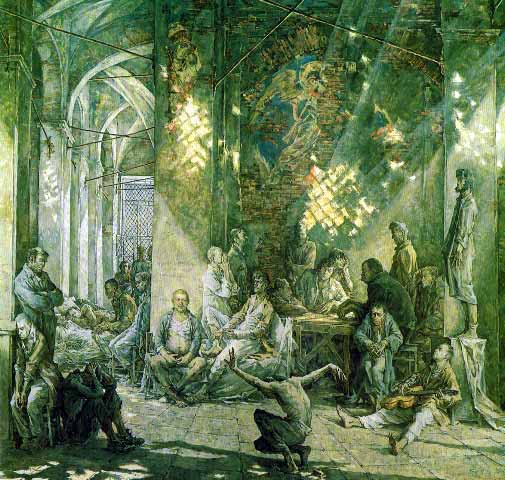
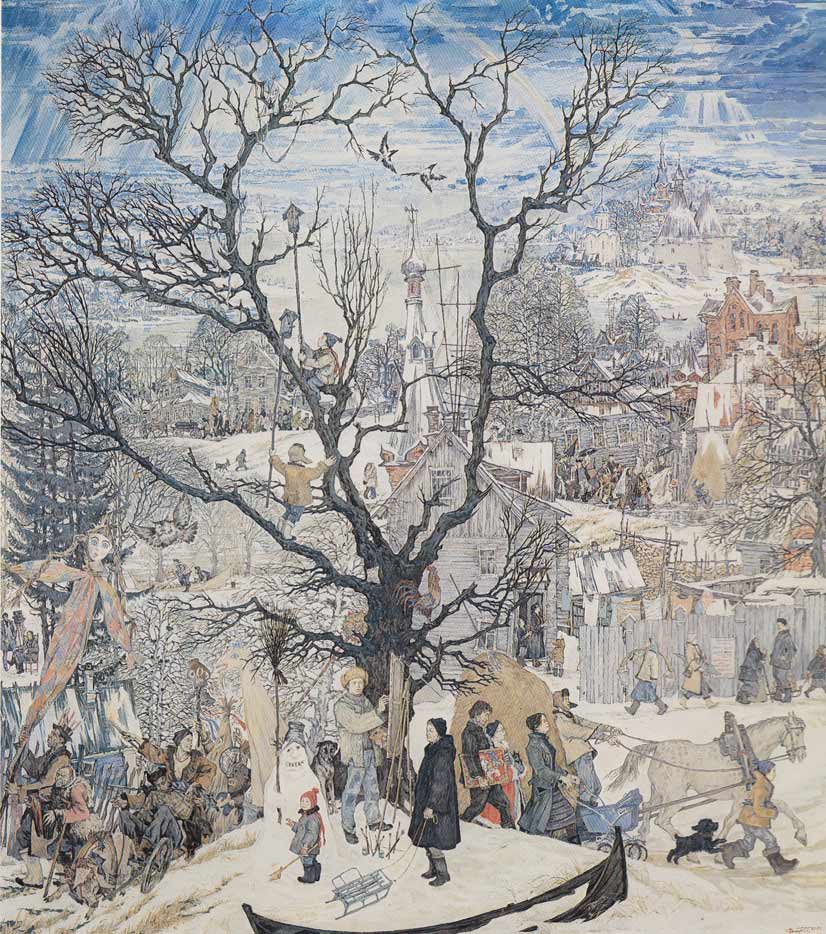
An exceptionally gifted drawer, well-versed in all techniques from watercolours and etchings to oils, ceramics and sculpture, he mastered all genres, from portraiture in which he excelled to composition which he favoured above all others. He loved to pit himself against the great masters he admired rather than giving in to the easy temptation of tabula rasa; to go against the tide of official art in the Soviet Union and, since moving to Paris, of a so-called “contemporary”, relativistic and nihilistic art in the West. All his life, Chepik was a free spirit who resisted dogmas and fashions, remained faithful to his artistic creed, and chose to paint both here and there “in season and out of season.”
His themes may be extremely diverse, but they form a distinctive and immediately recognisable world. There are the vast historiosophic compositions on Russia in which Chepik never ceases from one painting to the next to ponder over the tragic destiny of his homeland. There is above all the monumental religious painting, which had a special place for the Orthodox Christian artist that he was. There are also the teeming, phantasmagorical compositions in which his imagination bursts forth unbridled. But there are also themes that have their origins in his daily life in Montmartre and the numerous trips he made in France and Europe—Paris and the chimeras of Notre-Dame; Venice and its carnival; Arles and its bullfights, which he enthusiastically attended from 1994 onwards; sunflowers in homage to Van Gogh; and finally the world of the performing arts—circuses and acrobats, boxing rings, cabarets and the wings of the Moulin Rouge.
Chepik’s grave is located in the cemetery of Montmartre—near Rue Caulaincourt where he lived from 1991 until his death.